• WORK
  • Video BÚSQUEDA
  • Video" Life of Steen"
  • Instagram
  • About

Ingeborg Everaerd

PHOTOGRAPHY

  • WORK
  • Video BÚSQUEDA
  • Video" Life of Steen"
  • Instagram
  • About

BÚSQUEDA

A search for my son’s roots and the bond between us.

Since my son left our house at the age of 21 to live in an assisted home, the distance between us has increased. Literally and figuratively. That's why I wanted to take my son back to the country where he was born. A search ~ búsqueda ~ for his roots, with a little hope that it would awaken something in him.

But the chance that you build a bond with a place that you have left around your first birthday is small. And it doesn't get bigger if your body and mind have suffered considerable scars because you were born 14 weeks early.

It wasn’t an easy trip. Often my son was very quiet and introverted. I couldn’t figure out wat he was feeling or thinking. It made me sad to see him like this. Later he would say to me : ” Mom, I was a little overwhelmed”

 I will let you travel. You will see the love that I cherish for my son. It is a journey through Colombia, it is a journey through the emotional world of a complicated, but loving mother-son relationship. Life as it is. A continuous search.

A few months after our trip, my son started to open up and couldn’t stop talking about our trip together. Although he doesn’t want to go back (for now), he told me that he was proud to have Colombian roots.

*As a collaborative project, my son, also a rapper who writes his own lyrics, and I decided to create a video together. In this project, I used my son's raps, which he both wrote and performed. You can find it on this website.

AT SEA I DREAM OF LAND, ON LAND I DREAM OF SEA

In this story, I reflect on my friendship with a remarkable man named Steen, who sadly passed away last year. Steen was a nomad by choice, a man of wind and water devoted to a life without chains until fate clipped his wings.

I portray him in his final bloom.

Steen lived unbound, driven by the roads and rivers that called to him. He was not only a wanderer in his travels but also in his work. In his twenties, he was a photographer in the late sixties and early seventies. Now, decades later, the thousands of negatives he left me awaken his stories once more.

A year after we met, he was forced to leave his ship, the life he had built for over forty years.

A soul yearning for freedom, defying all odds and struggles, only to find itself ultimately confined by the limits of an aging body.

Only now do I realize how often Steen spoke of freedom in the past tense. I look at pictures of him as a young man in his twenties, full of dreams and possibilities. Then I look at the photos I took of him during the last five years of his life. The same man, but with a different gaze, the fragile core of an independent soul, captured in pure honesty.

When do we stop making plans for the future? When does that imperceptible shift occur?

Do we tell our stories to hold on to who we were, or to understand who we are now?

On January 13, 2024, Steen passed away in his camper, as he wished.

I am currently working on a photo book about Steen’s life, where his images and mine meet across time.

To see more of ‘ Life of Steen’ please watch the short docu, filmed by Trip to the Moon Films

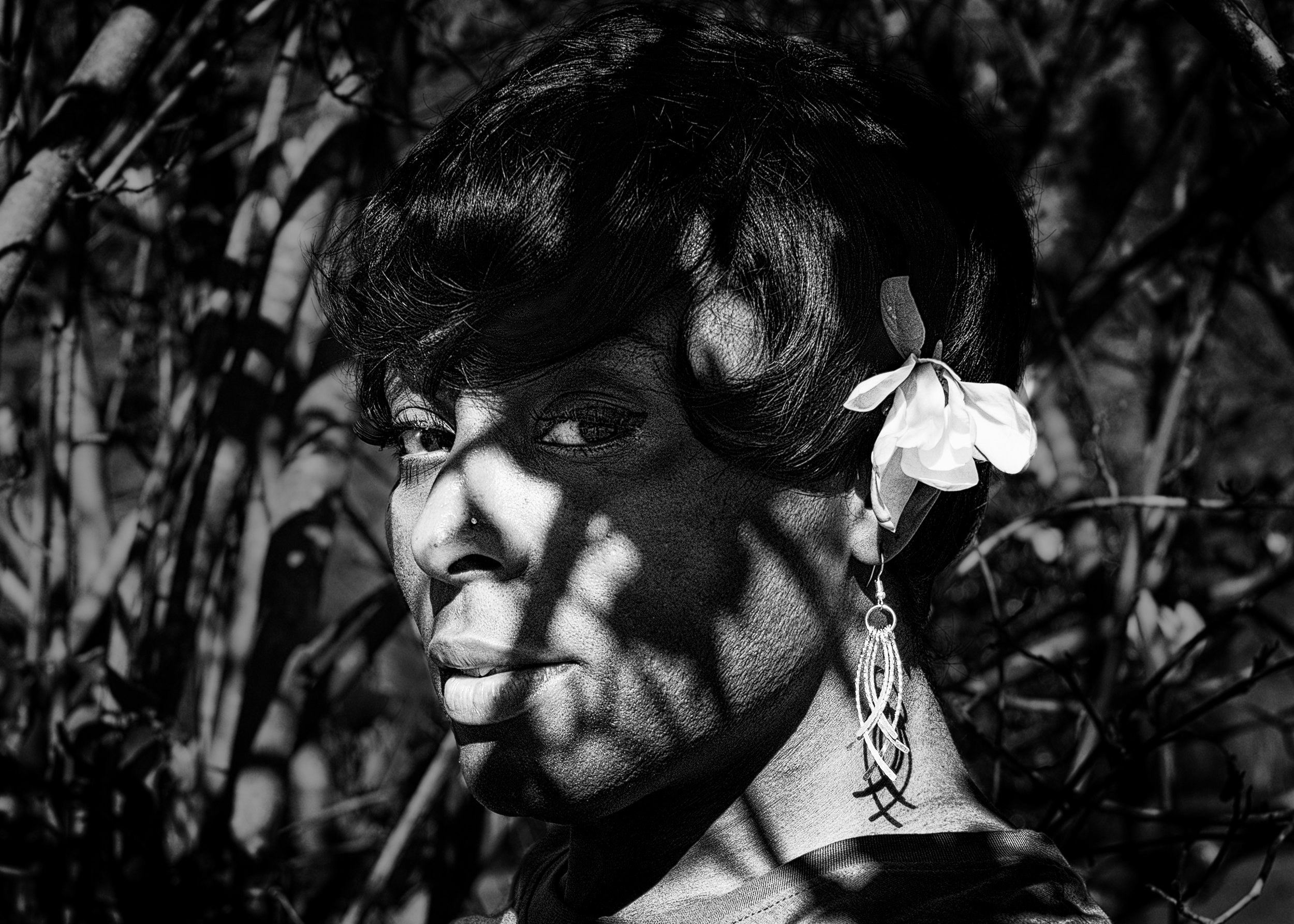
THERE AIN'T NOTHING SWEET ABOUT SWEET AUBURN

Black transgender women in the United States face disproportionate levels of violence, discrimination, incarceration, and limited access to healthcare and housing.

CC’s story reflects the reality many continue to live today. In recent years, and particularly since the political climate under Trump, conditions have become increasingly hostile, with growing attacks on trans rights and visibility.

Her life speaks to both resilience and vulnerability, and to a world that still struggles to make space for those who do not fit within its norms.

In 2017, in the shabby streets of Sweet Auburn, Atlanta, I met CC. She asked me to photograph her, and I said yes.

Then she disappeared.

Years later, her voice found me again, messages sent from inside a men’s prison: videos, letters, fragments of her days, small proofs of a life continuing out of sight. From a distance, I watched her try to survive a place built to erase her.

When she was released in 2023, I went back to keep my promise and see her again.

She was living on her mother’s couch, trying to rebuild something fragile. We moved through the city together, eating, shopping, laughing, while I photographed her. At times, without warning, something in her would fall quiet.

I didn’t always know how to be there. I only knew I didn’t want to look away.

A week after I left, she relapsed. Two weeks later, she died.

I returned once more for her funeral. She was buried as a man.

I know I will never forget her, and I am grateful, and proud, to have known her.

RIP my dear and brave CC.

A DANCER NEEDS TO DANCE

During a backstage photoshoot for the Dutch National Opera & Ballet in Amsterdam at the beginning of 2020, I met the Belgian dancer Nina Tonoli. She had recently moved to Amsterdam, leaving behind her boyfriend and the comfort of her life in Vienna to follow her dream of becoming a soloist with the Dutch National Ballet.

After the shoot, Nina asked if we could continue working together. Curious about the woman behind the ballerina, I agreed. I wanted to understand what it means to devote your life entirely to dance, especially for someone who had already spent years moving from country to country, chasing a dream that always seemed to exist somewhere else.

Then the world suddenly came to a standstill.

The rhythm that had shaped her entire life disappeared overnight. Years of training, rehearsing, and performing six days a week were replaced by silence and isolation. In a small apartment in Amsterdam, far away from her boyfriend and unable to perform before an audience, Nina tried to hold on to the only language she had ever truly known: movement.

Dancers trained alone through online classes, repeating exercises in living rooms and narrow hallways, trying not to lose the strength and discipline their bodies had been built upon for years. But what happens to a dancer when there is nowhere left to dance? What happens when the body longs for movement, but the world asks it to stand still?

The stillness of the pandemic gave us something that would otherwise never have existed: time. Time to meet again and again. Time to slowly discover the woman behind the elegance, perfection, and control expected of a ballerina.

Listening to Nina speak about dance was like listening to someone speak about love. Even through physical pain, loneliness, and sacrifice, her devotion never faded. Her personal life always seemed to come second to dance, yet she accepted this with a quiet determination that moved me deeply.

Some people choose dance.

For others, dance is as necessary as breathing.

Because in the end, a dancer needs to dance.

MARE

At first glance, Mare is like any other thirteen-year-old girl. But life in her family is different. Her brother has Duchenne muscular dystrophy, a progressive muscle disease that slowly takes away his strength and threatens his life. Simple things many families take for granted, going on holiday, eating out, or spending a day at the beach, are often difficult or simply impossible.

Mare helps wherever she can. She loves her brother deeply and sees how much her parents carry every day. Like any girl her age, she wants to spend time with friends and enjoy her teenage years, yet she often feels guilty afterward because her brother cannot share those experiences.

Over time, Mare has learned to live with the reality that her brother will not get better, that life will not become easier, and that even greater challenges lie ahead. Yet within this difficult reality, there is also warmth. The bond between Mare, her brother, and her parents is strong, loving, and deeply connected.

I started this project because Mare reminds me of my own daughter at that age. Although my son does not have a life-threatening illness, he is mentally disabled and also requires a great deal of care and attention. In the Netherlands there is a word for siblings like Mare and my daughter: “Brusjes.” The term combines the Dutch words for little brother (broertje) and little sister (zusje) and refers to siblings of children with disabilities or chronic illnesses.

From an early age, Brusjes understand that their sibling needs more care than they do. No matter how hard parents try to balance this, these children often grow up receiving less attention themselves. Many become especially caring and mature, instinctively helping their parents and supporting their sibling in every way they can.

PABLITO (Portrait Series)

Medellin, Colombia

Back in 1998, I traveled to Medellín, Colombia, to adopt my son. We had to stay there for a while to complete all the legal paperwork. However, Medellín wasn't a safe place at that time. A significant drug war was ongoing, even though Pablo Escobar, the infamous drug lord, had been dead for a few years. We felt scared and couldn't move around freely.

In 2014, I returned to Medellín for the first time since then and was surprised by how much safer it felt. Sure, there were still some areas where caution was necessary, but most people were genuinely friendly.

In 2018, marking the 25th anniversary of Escobar's death, I decided to visit Barrio Escobar, a neighborhood where Escobar had built 500 houses for the poor. The visit made me reflect on the complexity of his legacy and the resilience of the community.

It is estimated that Escobar was directly responsible for 8,000 murders. While the majority of Colombians view the violent era under Escobar as a dark chapter in their history, there are still individuals, both young and old, who idolize and romanticize him, denying his criminal actions. Escobar did provide various amenities for the poor.

However, I wonder why so many young people in this neighborhood still revere him, considering they weren't even born when he died. Is it because their parents and grandparents continue to uphold this adoration? These admirers affectionately refer to Escobar as "Pablito," the one who built their homes in Barrio Escobar.

Pablo Escobar was killed in his hometown on December 2nd, 1993.

Today, Barrio Escobar is a popular tourist spot, especially after the success of the well-known series "Narcos".

LOVE HAS NO COLOR GENDER,AGE, RACE OR RELIGION (Polaroid SX 70)

As a white mother of two adopted children of color, I have experienced prejudice firsthand. Sometimes it appears in subtle remarks or behavior from strangers, sometimes in painfully direct ways. Reactions shaped by ignorance or disapproval toward a family that does not fit what some people consider “normal.” As if love should only exist within what is familiar or socially accepted.

With this project, I want to show that prejudice does not stand in the way of love. People can love one another regardless of color, gender, age, race, or religion. By sharing these images, I hope to encourage people to look beyond their assumptions and become more open and compassionate toward others.

For this series I chose to work with vintage Polaroid SX-70 cameras. These old cameras are unpredictable — you never fully know how an image will turn out, just as you never know how people will respond.

The Polaroids were scanned, but I intentionally left the scratches, marks, and imperfections untouched. They reflect the emotional damage that can be caused by repeated exposure to prejudice, bluntness, and disapproval.

This project is made possible by “Het Steunfonds Freelance Fotografen” (Support Fund for freelance Photographers)

BÚSQUEDA

— view —

BUSQ WEB OK.jpg

AT SEA I DREAM OF LAND, ON LAND I DREAM OF SEA

— view —

Sjabloon website kopie xxx 2.jpg

THERE AIN'T NOTHING SWEET ABOUT SWEET AUBURN

— view —

Sjabloon website kopie 3.jpg

A DANCER NEEDS TO DANCE

— view —

DANCE WEB OK.jpg

MARE

— view —

MARE WEB OK.jpg

PABLITO (Portrait Series)

— view —

Sjabloon website kopie 2.jpg

LOVE HAS NO COLOR GENDER,AGE, RACE OR RELIGION (Polaroid SX 70)

— view —

Polaroid web ok.jpg

Copyright © 2025 Ingeborg Everaerd